
Willmar City Directory Collections
Willmar does not have one verified, complete online run of historical directories. The strongest starting points are a local directory lead, Minnesota Historical Society search staff, the Kandiyohi County Historical Society, and digitized newspaper titles. The 1927-1933 Willmar and Kandiyohi County taxpayer-directory lead has not been confirmed in an official catalog, so its publisher and full run should be treated as unverified until KCHS, FamilySearch, or a library catalog identifies the item. That uncertainty matters: a missing listing can reflect a missing volume, an incomplete collection, or an entry filed under a different form of the name.
| Collection | Years or run | Where held | Access |
|---|---|---|---|
| Willmar and Kandiyohi directory lead | 1927-1933 lead; 1927, 1929, and 1932 online leads | KCHS, library, and FamilySearch lead | Ask for taxpayer, city, telephone, and reverse volumes separately |
| MNHS directory or telephone search | Up to five selected years; holdings incomplete | Minnesota Historical Society | Staff search request with a stated city and years |
| Willmar Tribune and Weekly Tribune | 1895-1931 and 1931-1950; daily material begins in 1928 | Minnesota Digital Newspaper Hub | Search OCR, then inspect the issue image and page |
| Willmar vital-record finding aid | Certificates 1908-1952; registers 1914-1936; burial permits 1911-1926 | MNHS archive finding aid | Archive inquiry with restrictions and staff review |
| Kandiyohi township records | Six township collections microfilmed | KCHS, townships, and SMSU master copy | Research-room or staff inquiry |
The FamilySearch city and business directory collection provides a broad index and image route, but it does not establish a complete Willmar year list. Search its name, address, and occupation concepts carefully, then keep the edition year with any result. A local title should never be inferred just because a statewide collection exists.
The collection screen is a useful first check for indexed material, while KCHS and MNHS remain the better routes for a missing or unscanned Willmar volume.
Note: Directory evidence supports a listing on an edition date, not uninterrupted residence through the entire year.
Willmar Directory Leads, 1927-1933
The local lead describes a “Willmar, Minnesota, city directory” that also includes a Kandiyohi County taxpayers directory, with 1927 through 1933 material and separate online leads for 1927, 1929, and 1932. The research did not locate an official catalog record, publisher, or verified complete run. Ask the library or KCHS using the title words “Willmar city directory,” “Kandiyohi County taxpayers directory,” “criss-cross directory,” and “telephone directory.” Those terms may be cataloged separately, even when they refer to the same community and period.
For years without a local volume, Minnesota Historical Society's directory-search service can check one individual or business in up to five chosen years. Its listed choices are $10 for a city-directory search, $10 for a telephone search, or $20 for both, including a $5 nonrefundable processing charge. The listed response time is usually three to four weeks, with as much as twelve weeks, and the holdings are incomplete. Choose years at the start, middle, and end of a suspected interval rather than spending every request on consecutive dates.
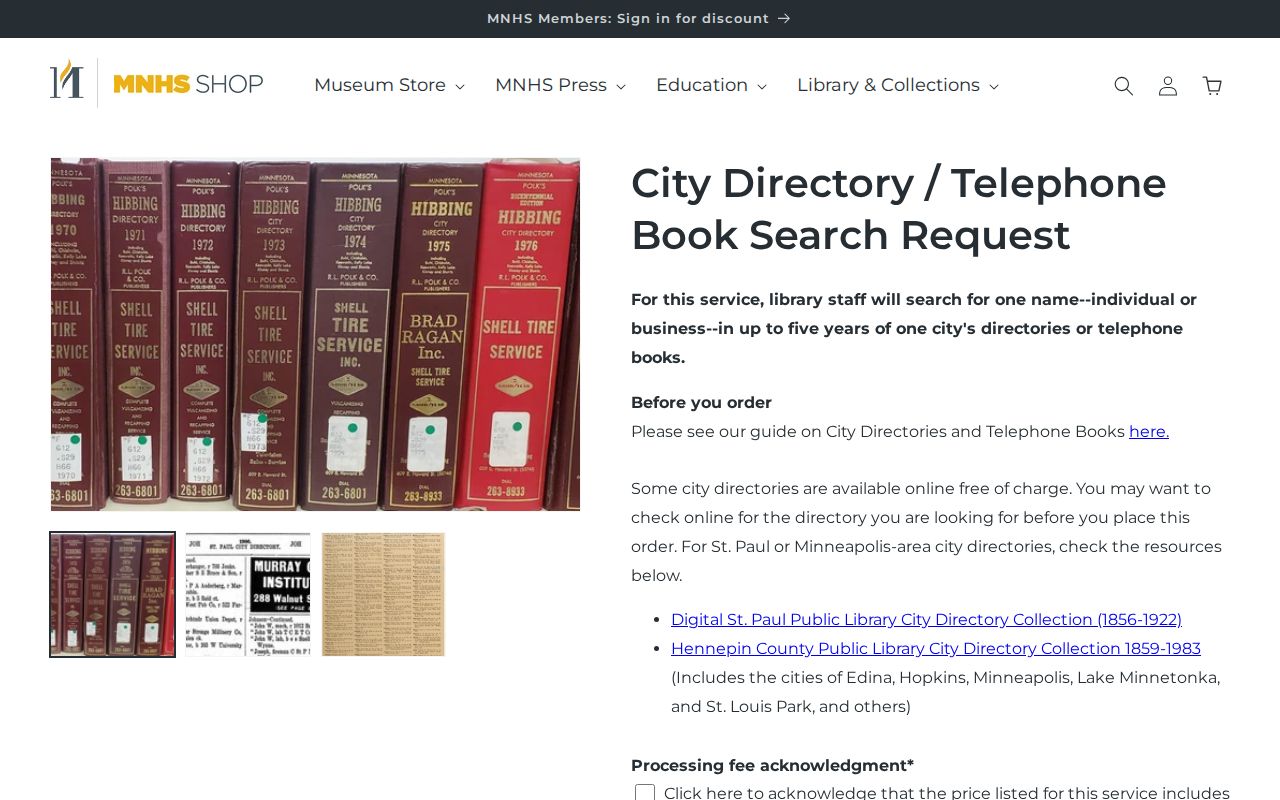
The request form makes the city, directory type, selected years, and extra context part of the search, so a specific address or name variation can make the inquiry more useful.
Willmar City Directory at KCHS
Willmar Public Library directs genealogy researchers to an important local handoff: the Heritage Searchers group and Genealogy Collection moved to the Kandiyohi County Historical Society Museum. The library page says the collection is available during museum business hours and that email requests are offered. That is a practical reason not to stop after a library-catalog search returns nothing. The museum's research library has local printed material, photographs, artifacts, genealogy support, early plat books, and microfilmed township records.
The Willmar Public Library genealogy notice identifies the move to the museum at 610 Highway 71 Service Road. Begin with the library's route, then ask KCHS research staff whether a title is held as a city volume, county taxpayer directory, telephone book, or a street-ordered copy. The underlying collection is more specific than a general online search and may have material that does not surface in public catalog pages.
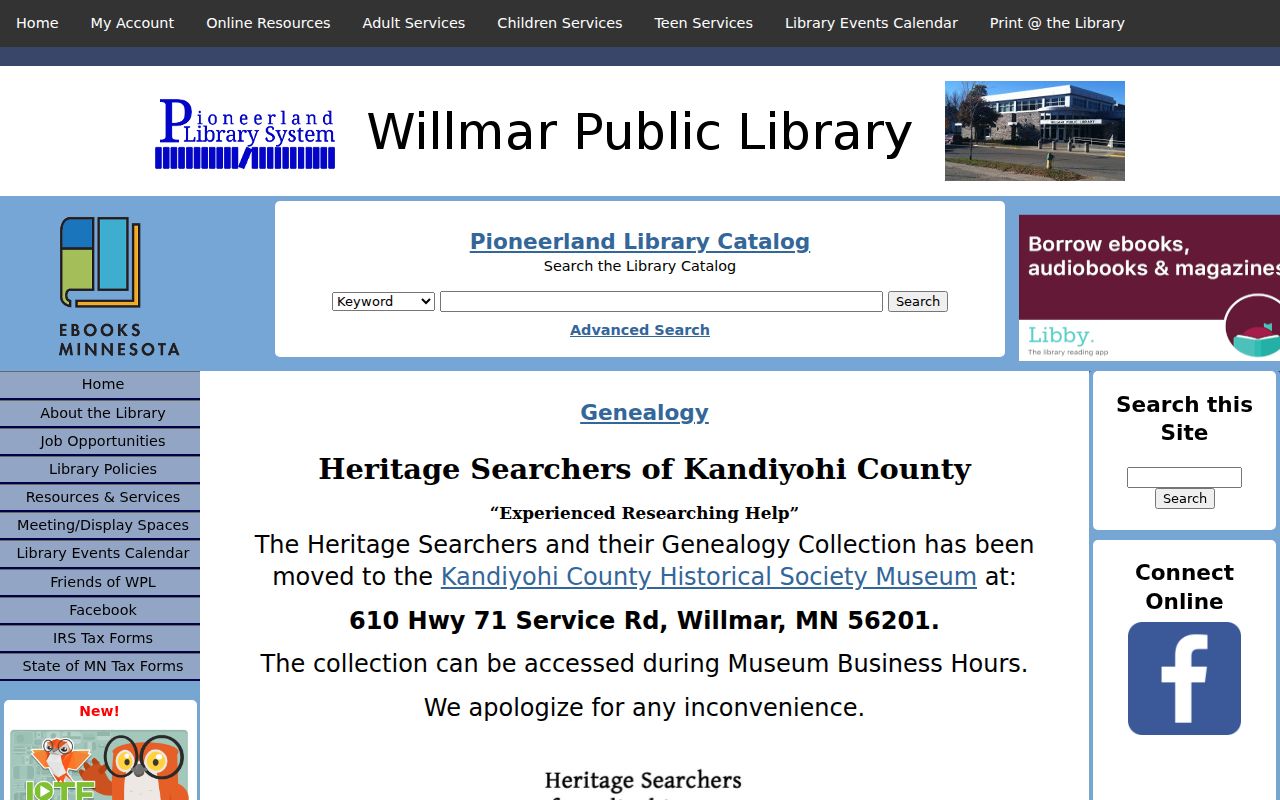
The library notice is a valuable routing record because it points a directory search toward the place where the local genealogy material was moved.
Kandiyohi County Historical Society lists its research and library contact in Willmar, and its staff page identifies research support. A KCHS newsletter reports that historical Victor Lawson Library material became a core research source after a 1968 gift. That provenance helps explain why older local printed sources may be found at the museum rather than in a current public-library shelf.

KCHS is the local place to ask about unpublished shelf runs, township microfilm, and directory companions whose exact public catalog entries were not located.
Reading a Willmar City Directory Entry
MNHS says its city directories are organized by head of household, while telephone books are organized by county. A printed entry may show a household name, spouse or other household context, a street address, and sometimes an occupation or business detail. The columns vary by edition. Preserve the original initials, spelling, punctuation, house number, directional, street suffix, page, and year rather than silently updating them to a modern form. An absent person may have been listed under another household member, outside city limits, or in an edition the repository does not hold.
| Name form | Keep surname, given name, initials, and any household notation exactly as printed. |
|---|---|
| Household context | Record spouse, widow, or relationship notation only when the edition prints it. |
| Address | Capture number, directional, street name, suffix, and edition year together. |
| Occupation or business | Retain this detail if printed, but do not assume every edition includes it. |
| Edition evidence | Save the page, publisher or source, alphabetical or street section, and abbreviation key. |
- Criss-cross directory
- A directory arranged by street and address rather than by surname, when an edition includes one.
- Householder index
- An alphabetical arrangement centered on the household name, which can omit another person living at the same address.
- Abbreviation key
- The edition's own explanation of shortened terms and marks. Photograph or transcribe it before expanding any notation.
Willmar City Directories and Tribune
Newspapers can test a directory entry against dated events. The Willmar Tribune title page identifies the Tribune from 1895 to 1931, the Willmar Weekly Tribune from 1931 to 1950, and a daily lead beginning in 1928. Other title leads include the Willmar Republican, Republican-Gazette, Argus, Journal, and Wilohi. A name search should use the title that matches the date, not only the Tribune name.
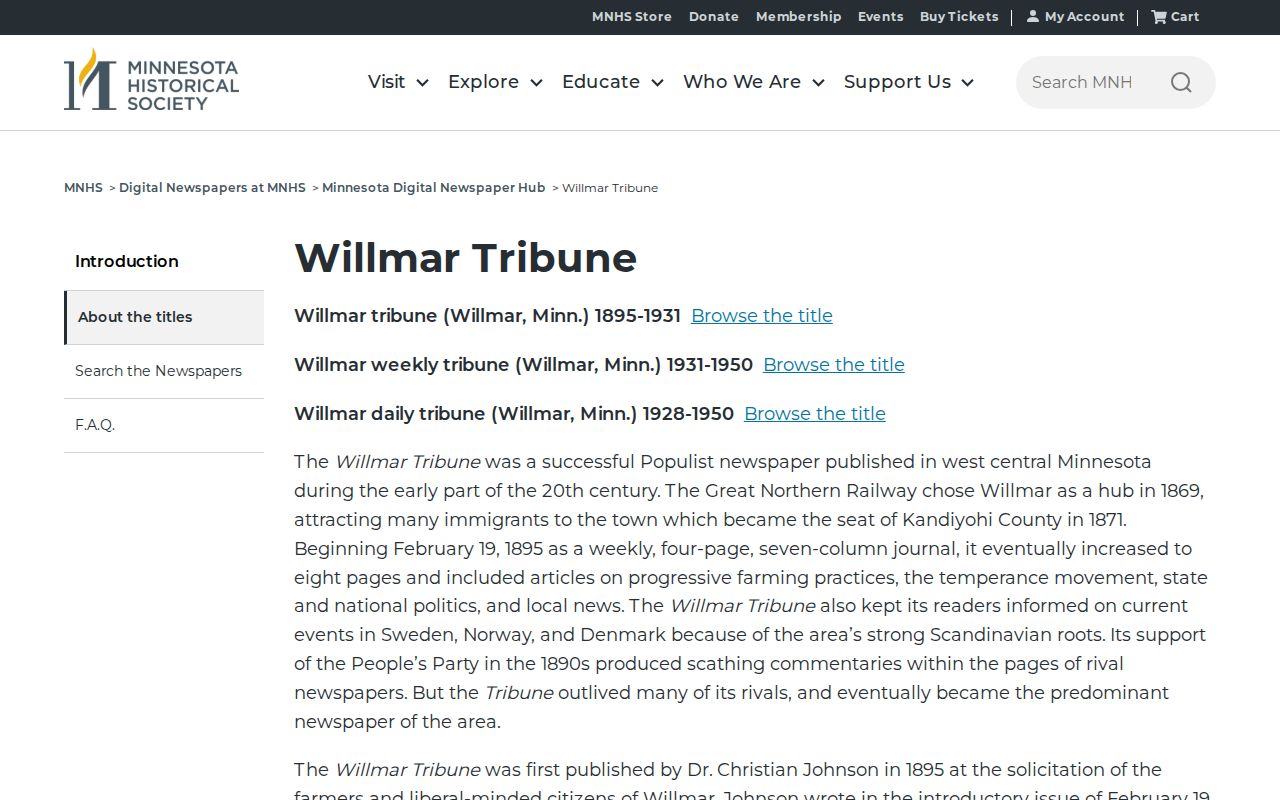
The newspaper hub lets a directory name be checked against notices, community references, marriages, obituaries, property sales, and civic events with an issue date and page.
OCR often misses Scandinavian names, hyphenation, initials, and small advertisements. Try a surname with the street, an initial with “Willmar,” a business or organization name, and a short date window. Keep the title, issue date, page, and image reference. A notice can support an event, but it does not supply a precise move date by itself.
Willmar Directory Years and Census
Trace a household across editions as a series of dated checks. The federal census is a separate dated enumeration, not a continuous record. Pairing it with directories can show whether a name, household role, and address are compatible across a decade, but differences need to be recorded instead of forced into one story. The available directory material is incomplete, so a gap may be a missing volume rather than a move.
- Start with the earliest confirmed surname or address and copy the edition date, page, and exact entry.
- Check the next available directory year, keeping changed initials, address forms, and household notation in a timeline.
- Use a street or criss-cross section only when the edition actually contains one, then compare the address spelling with the alphabetical entry.
- Pair the nearest released census year with the directory years, recording the enumeration date as its own evidence point.
- Use a newspaper, vital-record route, probate file, or deed only to test a particular change of date, place, or family context.
When a result needs a modern property check, the county's address-keyed tools are covered on the Willmar street directory route. Keep that current parcel evidence separate from a historical directory listing. Note: A census household and a directory entry may describe different dates, spelling choices, and household roles.
Willmar Township Records Before City
Some people found in Willmar later in life may first appear in Kandiyohi township material. A Minnesota Legacy project reports that six township record collections were microfilmed, with copies sent to the townships and the KCHS research library and a master held at Southwest Minnesota State University. KCHS also had a 42-roll microfilm project and helped Colfax recover lost records. These records can help connect a rural location or family name to a later Willmar entry.
This is not proof that every township resident moved into the city. Use the township source for a dated place and then look for a compatible directory, newspaper, deed, or census record. The rail hub established in 1869 and Willmar's county-seat role in 1871 help explain why county offices, newspaper titles, plats, and later city references converge in Willmar, while earlier family evidence can remain outside the city.
Willmar City Directory Gaps
A failed directory search has several local explanations. MNHS holdings are incomplete, its entries focus on heads of household, and the verified public library pages do not list a complete Willmar shelf or reverse-directory run. The possible 1927-1933 title is a lead, not a confirmed serial record. The library and KCHS also do not expose a named public obituary-index database or a complete cemetery lookup in the sources reviewed.
State the gap plainly in research notes: volume unavailable, year not located, entry not found under the name searched, or collection status unverified. Then ask KCHS whether the same place appears in a telephone book, taxpayer directory, township roll, newspaper file, or archive finding aid. That preserves the difference between an unsuccessful query and a conclusion about a person's history.